

The Echo Times: the journey continues
Welcome to our weekly exploration. We bring together four unique perspectives to answer one thought-provoking question each week, sharing insights, life philosophies, and reflections from the lake and beyond.

Written Waves
Reflection #4: Who and what Influenced You as a Child?
By Bert Russell | November 6, 2026
What influenced you the most growing up?
Was it your parents, grandparents, friends, teachers, or perhaps something you watched on television?
For me, it was advertising.
Magazine advertisements, television commercials, and eventually infomercials helped shape the person I thought I wanted to become.
Looking back, I made some pretty stupid decisions because of those advertisements.
Why?
Because I wasn't necessarily buying the product. I was buying the image, lifestyle, and personality the advertisement was selling.
Remember those Miller Lite commercials from the late 1970s through the mid-1980s? The celebrities, athletes, laughter, and good times? They made drinking beer look like a lifestyle worth experiencing.
I still drink Miller Lite today.
Then there were Marlboro cigarettes. The rugged cowboy, riding across the open countryside, representing independence and freedom.
I wanted to emulate that image, so I started smoking Marlboro Lights.
Ironically, Marlboro was originally marketed toward women before the company reinvented its image around the masculine Marlboro Man.
Later in life, I switched to American Spirit cigarettes. Their Native American-inspired branding and natural tobacco messaging caught my attention.
But here's the interesting part: American Spirit is owned by Reynolds American, part of the same tobacco industry whose history includes misleading the public about smoking.
Different packaging. Different message. Same addictive product.
Then came Mountain Dew. Its advertisements portrayed excitement, adventure, and people having the time of their lives.
Coca-Cola was different.
My grandmother drank Coca-Cola every day. She hated coffee, and so do I. I followed her example, not because of a television commercial, but because of the influence of someone I loved.
One brand sold me an image. Another became part of a family memory.
Isn't it amazing how our childhood experiences can influence our decisions decades later?
Companies understand this. They spend enormous amounts of money creating emotional connections with consumers, hoping those connections develop into lifelong brand loyalty.
A loyal customer can become a company's dependable source of revenue — what businesses sometimes call a cash cow.
But here's what fascinates me.
How many of our preferences are genuinely ours?
How many were planted years ago through repetition, imagery, family traditions, and clever marketing?
Like waves rolling toward shore, advertisements arrive one after another. Some disappear without leaving a trace. Others reshape the shoreline of our minds for a lifetime.
I can look back now and recognize how strongly those messages influenced me, including choices that weren't good for my health.
And that leaves me wondering:
Were we choosing the products, or were the advertisements choosing who we wanted to become?
Now It's Your Turn
What commercials or advertisements influenced you growing up?
Did you ever purchase something because you wanted to imitate the lifestyle or personality being advertised?
And here's the bigger question:
Are you still loyal to those brands today?
The Journey continues through the ECHO Series. ✌️
Written Waves | Reflection #4
www.lakelife4u.com
The ECHO Series
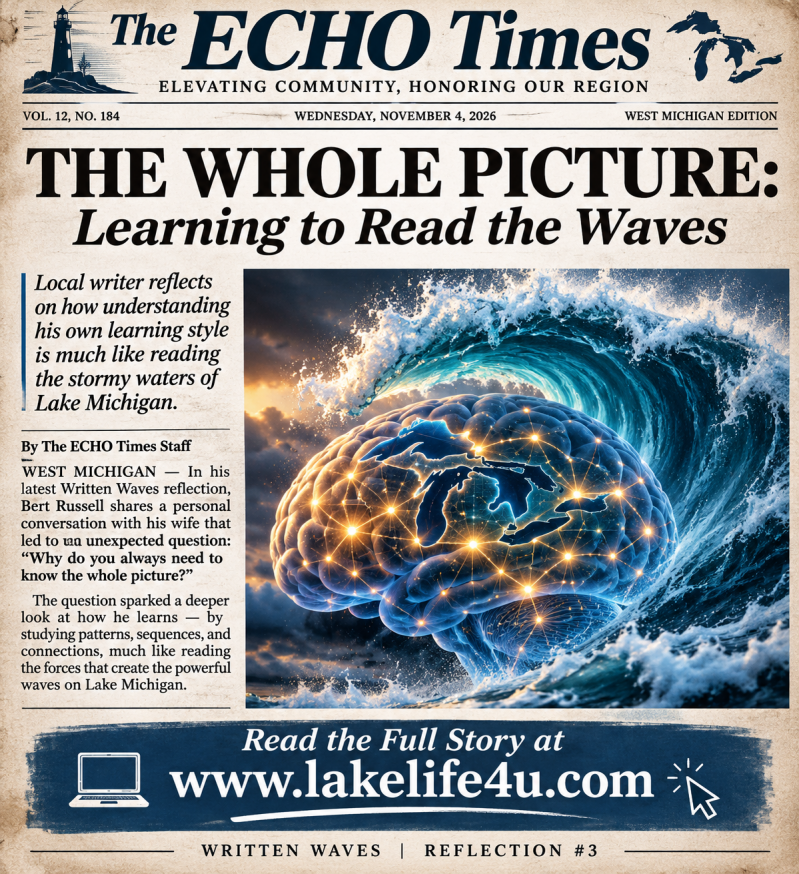
Written Waves – Reflection #3
The Whole Picture: Learning to Read the Waves
November 4, 2026
Have you ever stopped to think about HOW YOU LEARN?
I hadn't, until my wife asked me a simple question.
"Why do you always need to know the whole picture?"
Her question caught me off guard.
I explained that I don't like making rash decisions. I need to understand how everything works before deciding how to approach a problem. I study patterns, sequences, weaknesses, and potential failures. I try to anticipate problems before they happen.
I think I lost her somewhere around the second sentence!
But her question made me reflect on something I had never really considered. How does my mind actually learn?
The Stormy Waters of Lake Michigan
Imagine standing along Lake Michigan during a violent November storm.
The wind howls. Enormous waves crash against the shoreline. Most people see a dangerous storm.
But I see questions.
Where did the wind originate? Why are some waves larger than others? Why do they break in different locations? What is happening beneath the surface?
I don't just see the wave. I want to understand what created it.
That's how my mind approaches everyday life.
Whether planning transportation routes, improving business processes, or solving problems, I search for the relationships between all the moving pieces.
One small change can create a chain reaction, just like a storm developing over Lake Michigan.
Sometimes I recognize problems before they happen. Other times, I get caught in my own storm of endless questions.
Perhaps that's why my wife wonders why I need the whole picture.
Learning to Navigate
I've spent my entire life learning without ever questioning how I learn.
I see patterns, visualize processes, and connect information until the larger picture begins to make sense.
Maybe it's called systems thinking, pattern recognition, or visual-spatial learning.
I simply call it HOW MY MIND WORKS.
But here's what I've realized.
Not everyone sees the same storm the same way.
Some see crashing waves. Others see dangerous winds. Some see a lighthouse guiding them safely home.
And others, like me, wonder what forces brought those waves to shore in the first place.
We all navigate the same waters, but we don't necessarily read the waves the same way.
My wife asked one simple question, and it created a wave of reflection I never expected.
Now I have one question for you.
DO YOU KNOW HOW YOUR MIND LEARNS?
The Journey continues—baby steps. ✌️
Education is the key. Teaching is the degree.
— Bert Russell
Written Waves - www.lakelife4u.com
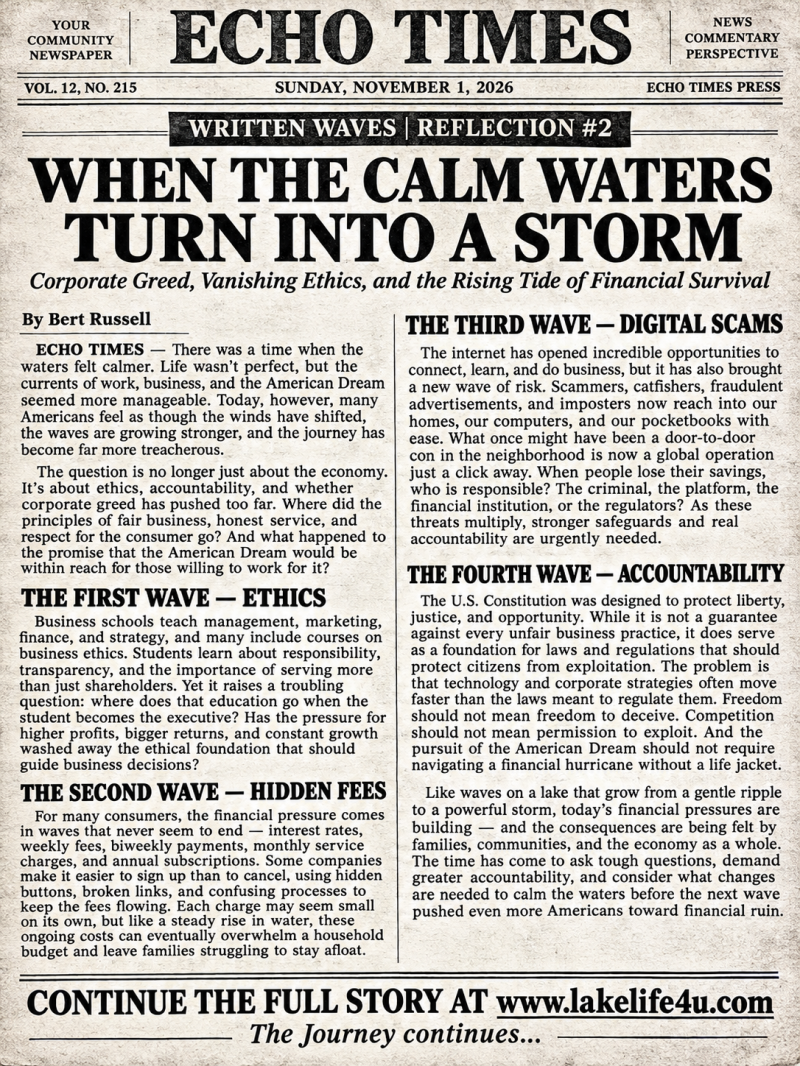
When the Calm Waters Turn Into a Storm
Written Waves
Reflection #2
By Bert Russell | November 1, 2026
There was a time when the waters seemed calmer.
Not necessarily perfect. There have always been storms, unpredictable currents, and dangerous waves. But somewhere along the journey, it feels as though the winds have shifted, the currents have strengthened, and the waves have grown increasingly difficult to navigate.
I am not talking only about our oceans, rivers, and lakes.
I am talking about the waves of society, business, economics, and corporate greed.
What happened to ethics?
When did making a reasonable profit become less important than extracting every possible dollar from the consumer?
When did customer service become a maze of automated messages, broken links, hidden cancellation buttons, and endless subscriptions?
And when did the American Dream begin to feel like an obstacle course designed to drain our financial resources before we ever reach the finish line?
The First Ripple: Education and Ethics
Business schools teach marketing, management, economics, accounting, and finance.
But what about ethics?
Business ethics is taught in many educational programs. Students learn about corporate responsibility, fairness, transparency, and the importance of making decisions that benefit more than just shareholders.
So where does that education go when the student becomes the executive?
Does it disappear when quarterly earnings fall short?
Does the pressure to satisfy investors wash away the principles learned in the classroom?
Or have we gradually created an economic environment where success is measured almost exclusively by revenue, growth, and profitability?
I studied Marketing Management, and I have always believed that a successful business should create value for both the company and the customer.
Profit is not the enemy. Greed without accountability is the danger.
A healthy business should resemble a healthy body of water. It needs movement, circulation, balance, and an environment where life can flourish.
When one force begins taking more than the system can replenish, the balance changes.
And eventually, the waves begin to rise.
The Second Wave: The Subscription Storm
Look around at the financial currents surrounding the average American household.
Interest rates. Weekly fees. Biweekly payments. Monthly service charges. Annual subscriptions. Convenience fees. Processing fees. Administrative fees.
Some companies even make it easier to subscribe than to unsubscribe.
One click to enter.
A dozen obstacles to escape.
A cancellation button that seems to disappear beneath the surface.
A link that leads nowhere.
A telephone number that connects to another automated system.
Each charge may appear insignificant by itself.
Five dollars here. Twelve dollars there. Twenty-five dollars somewhere else.
But water does not need to arrive as a tidal wave to cause damage.
A small leak, left unattended, can eventually sink the entire boat.
And that is what concerns me.
We are surrounded by financial leaks, many of which consumers do not notice until the water is already rising.
The Third Wave: Scammers and Digital Predators
The internet was supposed to connect the world.
And in many remarkable ways, it has.
We can communicate across oceans, operate businesses from our homes, learn new skills, and share our experiences with people we may never meet.
But another current flows beneath the surface.
Scammers. Catfishers. Fraudulent advertisements. Impersonators. Deceptive websites. False promises.
Technology has given honest people extraordinary opportunities.
Unfortunately, it has also given dishonest people extraordinary reach.
A scammer no longer needs to knock on your front door.
They can reach into your home through a cellphone, email, social media account, or fraudulent payment request.
And when someone loses their savings, who is responsible?
The criminal?
The platform?
The financial institution?
The regulators?
Perhaps responsibility should not rest on only one set of shoulders.
When the storm is approaching, everyone responsible for maintaining the seawall should be paying attention.
The Fourth Wave: Where Are the Safeguards?
I have been thinking about the United States Constitution and the principles upon which this country was founded.
Liberty. Justice. Opportunity. Freedom.
The Constitution established a framework for government and protections against certain abuses of governmental power. It was not written as a guarantee against every unfair business practice or financial hardship.
But that raises another question.
What responsibilities do our elected representatives have to protect citizens from modern forms of exploitation?
We do have consumer protection laws, financial regulations, fraud statutes, and agencies responsible for enforcing them.
Yet laws are only as effective as their enforcement.
And technology often moves faster than legislation.
When a corporation can make billions of dollars through complicated pricing structures, difficult cancellation procedures, or excessive financial charges, the average consumer may feel powerless.
Freedom should not mean freedom to deceive.
Competition should not mean permission to exploit.
And the pursuit of the American Dream should not require navigating a financial hurricane without a life jacket.
The Fifth Wave: When Nature and Economics Collide
Now imagine standing beside a peaceful lake early in the morning.
The surface is nearly motionless.
A gentle breeze creates the first ripple.
As the wind strengthens, the ripples become waves.
The waves grow larger, and the once-peaceful water becomes increasingly difficult to navigate.
Nature teaches us that waves respond to forces.
Wind transfers energy into the water. Storm systems intensify the movement. Underwater earthquakes can generate tsunamis. Climate change contributes to rising sea levels through melting land ice and warming ocean water, increasing coastal flooding risks.
Different forces. Different mechanisms.
But each demonstrates how changes within a system can create consequences far beyond their point of origin.
Our economy behaves similarly.
A small increase in a household expense may seem harmless.
But combine higher borrowing costs, rising insurance premiums, subscription charges, housing expenses, and everyday necessities.
Suddenly, the family that once navigated calm waters is struggling against powerful currents.
The financial storm does not always arrive overnight.
Sometimes it develops one small wave at a time.
The Sixth Wave: Who Pays When the Ship Sinks?
Here is another question that troubles me.
When an individual cannot pay their bills, the consequences can be devastating.
Credit scores fall. Property may be lost. Debt collectors begin calling. Bankruptcy may become the only remaining option.
But what happens when a major corporation makes reckless decisions?
Sometimes companies restructure through bankruptcy. Sometimes investors and creditors absorb the losses. And in certain circumstances, governments intervene when broader economic stability is threatened.
Not every corporate failure becomes a taxpayer bailout.
But when public money is used to rescue private institutions, citizens have every right to ask difficult questions.
Why should profits remain private while certain losses become public responsibilities?
Why are ordinary families expected to manage every financial mistake while some enormous institutions may receive extraordinary assistance?
I believe accountability should flow in both directions.
If businesses benefit from the communities they serve, they should also recognize their responsibilities to those communities.
Otherwise, the waves of financial distress may continue spreading outward.
And eventually, even those standing on higher ground may feel the effects.
The Seventh Wave — Can We Calm the Waters?
I do not believe every corporation is greedy.
There are honest business owners, ethical executives, dedicated employees, and companies that genuinely care about their customers.
I also believe businesses deserve to earn profits. Without profits, they cannot consistently employ workers, invest in innovation, or continue serving their communities.
But there must be balance.
Transparent pricing.
Straightforward cancellation procedures.
Reasonable and clearly disclosed fees.
Effective consumer protections.
Meaningful consequences for fraud.
And an understanding that customers are human beings, not simply numbers on a financial statement.
Perhaps the solution begins with education.
Not simply teaching students how to generate profits, but teaching future business leaders how their decisions affect families, communities, and the environment.
Education is the key. Teaching is the degree.
Ethics should not be something we study for an examination and then leave behind in the classroom.
It should become part of every decision we make.
The Final Reflection: The Journey Continues
I keep returning to the image of a small boat floating across an enormous body of water.
At first, the water is calm.
The horizon is visible.
The destination seems attainable.
But the wind begins to strengthen.
One wave strikes the boat.
Then another.
And another.
The passengers begin spending more energy keeping the water out than moving toward their destination.
Is that what is happening to the American Dream?
Are we spending so much time surviving the financial waves that we have forgotten where we were trying to go?
I do not have all the answers.
But I believe we need to start asking better questions.
Who benefits from the system we have created?
Who bears the greatest risks?
And how much rougher must the water become before we decide that something needs to change?
We cannot control every storm nature sends our way.
But corporate policies, business ethics, consumer protections, and financial accountability are human decisions.
And human decisions can be changed.
Perhaps we cannot calm the entire ocean overnight.
But we can begin by changing the direction of one current.
One decision.
One act of accountability.
One small ripple.
Because sometimes the smallest wave is the beginning of the greatest change.
The Journey continues...
Bert Russell
Written Waves | First Perspective
www.lakelife4u.com
WRITTEN WAVES
First Perspective - TheECHO
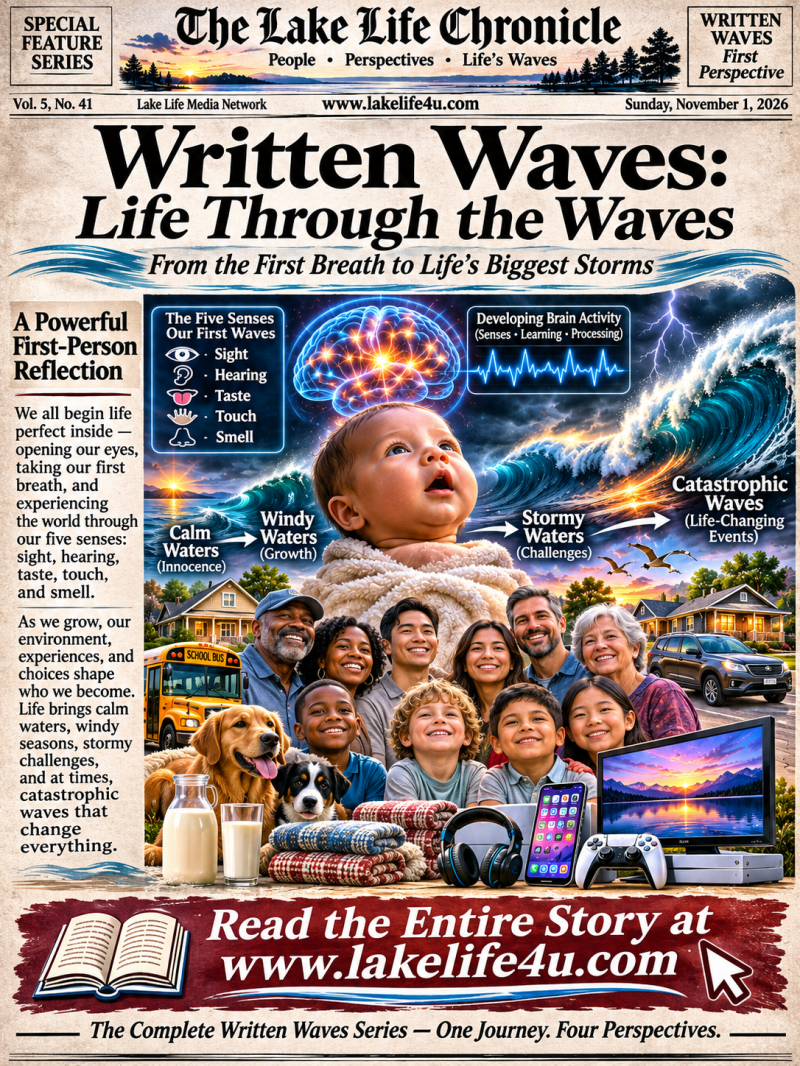
We Were All Born Into the Same Ocean
By Bert Russell | November 1, 2026
One Journey. Four Perspectives.
The First Wave — The Beginning of Life
We all begin our journey in much the same way.
We enter this world innocent, untouched by the prejudices, expectations, and judgments of society. We have not learned hatred, greed, jealousy, or resentment. We have not yet developed the opinions that will eventually separate us from one another.
We open our eyes and take our first breath.
And then, we cry.
Perhaps it is the shock of leaving the only environment we have ever known. For months, we floated in the protective waters of our mother's womb. We were surrounded by warmth, movement, and the rhythmic sounds of life.
Then suddenly, everything changes.
The umbilical cord is cut. Our physical connection to our mother changes, and our independent journey begins.
Our first wave has arrived.
We have entered an ocean we do not yet understand.
The Five Senses — Learning to Read the Waves
Our minds are not completely blank when we are born. We have already begun developing and responding to sensations before birth. But the world outside introduces an extraordinary collection of new experiences.
Our five senses become our earliest navigational instruments.
SIGHT: The bright lights of a hospital delivery room, the shadows of people moving around us, or perhaps the softer natural lighting of a home birth. Our eyes begin adjusting to a world filled with shapes, movement, and colors.
HEARING: The clanking of medical instruments, the conversations between doctors and nurses, the familiar voice of our mother, and the unfamiliar voices of strangers. Sounds become signals that our developing brains begin learning to recognize.
TASTE: Our earliest experiences of feeding introduce flavors and sensations. Over time, our sense of taste will help shape preferences, memories, and even emotional connections to food.
TOUCH: The sensation of water washing across our skin, the warmth of another person's hands, the softness of a blanket, and the comforting embrace of someone holding us close.
SMELL: The scents of our surroundings. Fragrant soaps, detergents, perfume, body odor, and the familiar scent of our mother. Eventually, smells will become powerful reminders of people, places, and moments in our lives.
Each sensation is like a small wave reaching the shoreline.
Some waves are gentle. Others are unfamiliar and overwhelming.
Our brains begin organizing these signals, recognizing patterns, developing memories, and learning how to respond.
We are learning to navigate.
Calm Waters — The Innocence of Childhood
Imagine a beautiful lake early in the morning.
The water is perfectly calm. The surface reflects the trees, clouds, and rising sun. There are no boats creating wakes, no powerful winds, and no approaching thunderstorms.
Everything appears peaceful.
Childhood can begin much like that lake.
We learn to smile, laugh, crawl, walk, and eventually speak. We discover the excitement of touching grass, watching birds, hearing music, and splashing in water.
But even during these early years, our surroundings begin creating ripples.
Our parents, siblings, relatives, neighbors, teachers, and communities influence how we interpret the world.
Some children grow up surrounded by encouragement and affection.
Others experience fear, instability, poverty, neglect, or conflict.
We may all begin life with equal human worth, but we do not all begin with equal circumstances.
And the waters surrounding us are not always calm.
Windy Waters — The Development of Who We Are
As we grow older, the winds begin changing direction.
Our bodies change. Our voices deepen or mature. Our interests evolve. Our understanding of the world becomes more complicated.
We develop likes and dislikes.
We discover what frightens us, excites us, motivates us, and makes us uncomfortable.
One person may love the peacefulness of a mountain stream. Another may prefer the excitement of a crowded city.
Some people are naturally outgoing. Others prefer quiet observation.
Some learn through listening. Others learn through seeing, touching, experimenting, and experiencing.
Our individual DNA contributes to our uniqueness, but so do our environments, experiences, relationships, and decisions.
Think about the wind blowing across a lake.
The wind may be coming from the same direction, but every wave behaves a little differently. Some rise higher. Others disappear beneath larger waves. Some travel great distances before reaching the shoreline.
Human beings develop in similar ways.
We share the same world, yet experience it differently.
No two journeys are exactly alike.
Stormy Waters — When Life Challenges Us
Eventually, almost everyone encounters storms.
Disappointment.
Rejection.
Financial hardship.
Illness.
Broken relationships.
Loss.
Fear.
And sometimes, the consequences of our own decisions.
These experiences can change the way we view ourselves and others.
A person who once trusted everyone may become suspicious.
Someone who was once compassionate may become bitter.
A confident individual may begin questioning their abilities.
But storms can also produce unexpected growth.
A frightened person may discover courage.
A selfish person may learn generosity.
Someone who has experienced hardship may develop extraordinary compassion for others.
The storm itself does not guarantee what we will become.
What matters is how we respond, the support available to us, and what we learn while navigating those difficult waters.
And sometimes, survival itself is an accomplishment.
Catastrophic Waves — When Everything Changes
Not every storm is ordinary.
Sometimes life delivers a wave so powerful that everything familiar disappears.
Imagine a tsunami approaching a coastline.
The water may initially retreat, exposing areas of the ocean floor that have remained hidden for generations.
Then the enormous wave arrives.
Buildings collapse. Roads disappear. Familiar landmarks are destroyed. The coastline itself may change.
Human lives can experience equally devastating turning points.
The death of a loved one.
A devastating injury.
The loss of a home.
A traumatic experience.
A decision that changes the direction of an entire family.
These moments can permanently reshape our emotional landscape.
Some people rebuild quickly. Others require years. Some carry the effects throughout their lives.
We should never assume that everyone has the same ability, resources, or opportunities to recover.
But even after catastrophic destruction, new beginnings are possible.
The shoreline may never look exactly the same.
And perhaps neither will we.
The Changing Tide — The Choice to Become Someone Different
Here is something I find fascinating about human beings.
We are constantly changing, even when we do not recognize it.
Our attitudes change.
Our beliefs evolve.
Our bodies age.
Our relationships develop or disappear.
Our priorities shift.
The person we were at ten years old is not the same person we became at twenty, thirty, forty, or fifty.
And the person we are today does not have to be exactly who we become tomorrow.
We cannot choose our DNA, the circumstances of our birth, or every wave that reaches our shoreline.
But we can sometimes choose how we respond.
We can choose to learn.
We can choose to apologize.
We can choose to forgive.
We can choose to seek help.
We can choose to treat another human being with dignity.
We can recognize behaviors we dislike about ourselves and begin taking baby steps toward changing them.
Not every change happens overnight.
Some require patience, encouragement, and tremendous effort.
Think about a single wave washing across a rocky shoreline.
One wave may accomplish almost nothing.
But thousands of waves, arriving day after day, can gradually reshape the landscape.
Small changes can produce extraordinary results over time.
The Final Wave — Are You Happy With Who You Are?
I began this reflection with the idea that everyone enters the world perfect on the inside.
Perhaps perfection is not the right scientific description. We are born with differences, vulnerabilities, and individual characteristics.
But I believe we begin with something far more important.
Human worth.
Before society teaches us to judge one another by wealth, appearance, education, occupation, race, or social standing, we are simply human beings beginning a journey.
We are not born knowing whom to hate.
We are not born understanding greed.
We are not born believing that one person's life is more valuable than another's.
Those ideas develop through a complicated mixture of experiences, influences, and choices.
And just as we can learn certain behaviors, we can sometimes learn to change them.
Life is an endless ocean of experiences.
There will be calm mornings.
There will be windy afternoons.
There will be thunderstorms that frighten us.
And occasionally, catastrophic waves that change everything we thought we understood.
But the ocean never remains exactly the same.
Neither do we.
So, I want to leave you with a question.
Are you happy with the person you have become?
And if the answer is no, what is preventing you from beginning to change?
You do not have to change the entire ocean.
Perhaps you only need to begin with one small wave.
One decision.
One act of kindness.
One apology.
One moment of understanding.
One baby step.
The Journey continues... baby steps. ✌️
---
WRITTEN WAVES — FIRST PERSPECTIVE
The ECHO Series | One Journey. Four Perspectives.
www.lakelife4u.com
By Bert Russell

Written Waves:
Dreams Beyond the Storm
The First Perspective
On my way to work Saturday morning, I realized that life’s storms don’t always arrive with dark clouds. Sometimes they arrive as obligations that change the weekend you had planned.
I was supposed to go to Beaver Lake. I had a chance to learn how to wakesurf from someone close to a professional. For a little while, I pictured myself riding a wave instead of trying to keep up with everything on shore.
But the forecast changed. Responsibilities I couldn’t move took priority, and my plans washed away.
That disappointment stirred up a familiar question: When will I get to live more of the life I keep working toward?
I need the stability of a dependable job, and I truly enjoy my career. How many people can honestly say they like what they do for a living? It took me years to find work that fits the way my mind moves.
Still, enjoying my work doesn’t mean every wave is easy to ride.
My paycheck isn’t what some of my high school friends earn. My lifestyle isn’t everything I hoped it would be by now. Those comparisons can gather like a tropical storm—one thought feeding another until the water in my own mind becomes rough.
I start measuring my progress against somebody else’s shoreline.
But I don’t know every storm they have weathered. I know mine. I know how long it took to get here, and I know there are things about this life worth holding onto while I work toward something more.
Sometimes the waves come close together: work, bills, obligations, postponed plans. Before I catch my breath from one, another rolls in. On those days, treading water takes all I have.
I am learning to give myself credit for staying afloat.
I will keep taking baby steps toward my dreams. Some steps will mean working. Others will mean protecting time to rest, explore, and finally get out on that lake.
I missed my chance to learn wakesurfing this weekend. That matters to me. But one changed weekend doesn’t decide the rest of my journey.
The storm will pass. The waves will eventually settle.
And when the opportunity comes again, I want to be ready to ride. ✌️
The ECHO Times
Lawrence and Ralphy:
A Memory and a Handshake
I met up with Lawrence and Ralphy again on Sunday. I arrived at the cemetery to pick them up at four in the morning, but before we left, Lawrence brewed a cup of black tea.
We sat looking out at the Kansas City skyline, sipping his coffee and my tea. Ralphy drank water from a large, discarded Folgers coffee can. I had brought a jug of purified water to help a little. It was the least I could do for our friendship.
There was no hurry in that moment.
I asked Lawrence what he had been studying at the library. Then I asked whether he remembered anything from childhood that might bring back a good memory.
He thought for a minute.
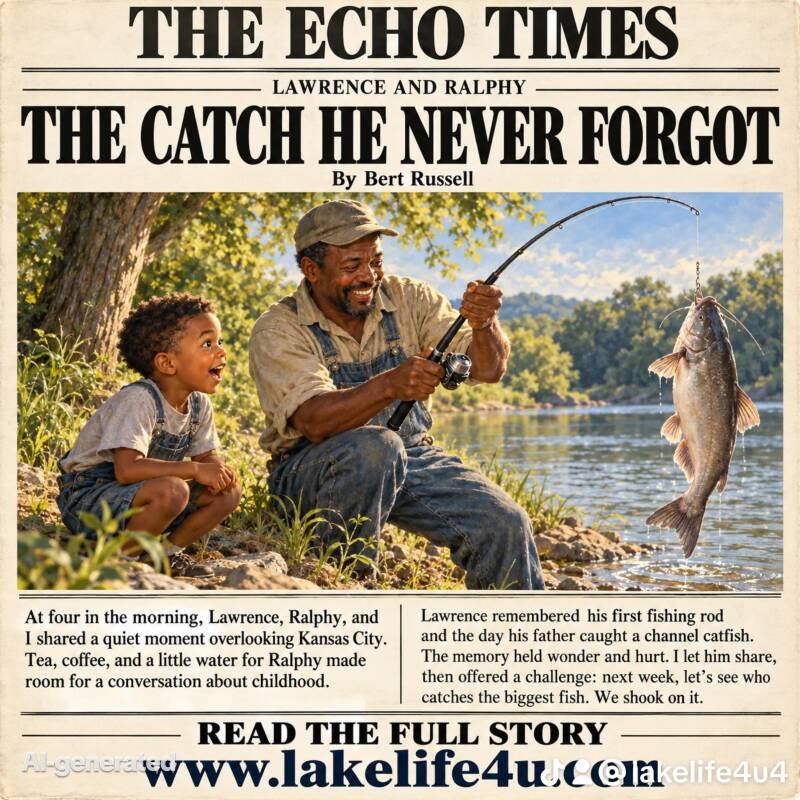
“I remember a gift my father gave me when I was about five or six,” he said. “It was a Zebco reel with a graphite rod. We went fishing that day. He took me to the river, and we fished for hours on the bank.”
“Did you catch anything?” I asked.
“A bunch of trees and brush,” he said. “But no fish.”
Then he told me about his father taking the rod.
“My dad cast it one time and slowly reeled it back, and BOOOOM! He caught a channel catfish. I was so amazed. He could do stuff like that. He could do so many things that amazed me.”
Then the memory turned.
“But he couldn’t keep a job or stop hitting my mother. He left not very long after that.”
I had asked him for a good memory. He had given me one, but there was pain attached to it that I hadn’t expected.
Man, I thought. That conversation got dark quickly.
I didn’t press him for more. He had shared what he wanted to share, and I let it rest there.
Instead, I threw out a challenge.
“How about you and I go fishing next week? Let’s see who can catch the biggest fish.”
I held out my hand.
“Is it a bet?”
We shook on it.
That morning started with tea, coffee, and a dog drinking from an old coffee can. Somewhere in the conversation, we found a fishing rod, a channel catfish, and a childhood memory that held both wonder and hurt.
By the time we left, we had a fishing challenge ahead of us.
I don’t know who will catch the biggest fish. After hearing about all those trees and brush, I figure I might have a chance.
But Lawrence has caught a channel catfish before.
And now we have a handshake to honor. ✌️

ECHO TIMES
Our Journey continues...
Lawrence and Ralphy:
A Quiet Place Above the City
At the cemetery, Lawrence led me down a steep hill toward his camp. Brush covered the slope, and huge oak trees sheltered the little place he had found. As we made our way down, I began to understand why he had chosen it.
Hidden among the trees was a gorgeous view of the Kansas City skyline.
I was impressed. This was more than I could have imagined. Lawrence had thought about both beauty and security—a place tucked away from passing eyes, where he could still look out over the city.
Then Ralphy stepped out from behind a tree, as if he already knew I was there. His tail was wagging, and he came over and sat beside me.
That familiar welcome was refreshing. Before we had even settled in, Ralphy had made me feel at home.
Lawrence stoked the small fire and offered me something to drink.
“I have tea,” he said, “but no ice.”
“That’s cool,” I told him. “I’ll let it cool.”
Such a simple exchange. Yet there was something meaningful about standing in the place Lawrence called home and having him offer me a drink. That morning, I was his guest.
We sat together with Ralphy beside us, looking toward the horizon. For a while, neither of us spoke.
I had arrived with my mind racing, unsure of what I would find beyond the cemetery gate. Now I was sitting beneath huge oak trees, beside a small fire, watching the city with a friend and his dog.
For that moment, I didn’t need to figure anything out.
I let the tea cool, and we watched the horizon.
Our Journey continues... ✌️
THE ECHO TIMES
WRITTEN WAVES
What the Waves Leave Behind
By Bert Russell
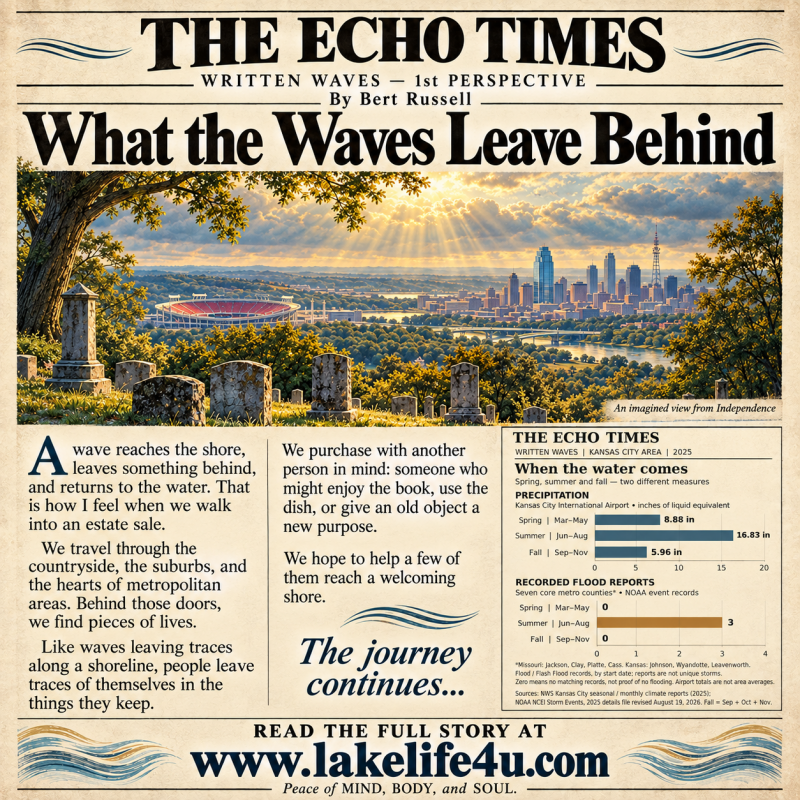
A wave reaches the shore, leaves something behind, and returns to the water.
Sometimes it carries a small piece of yesterday. Sometimes it uncovers something that has been buried for years. And sometimes, someone walking along the edge notices what everyone else has passed by.
That is how I feel when we walk into an estate sale.
We travel through the countryside, the suburbs, and the hearts of metropolitan areas. Our journey has taken us through New York, the Carolinas, Texas, California, Nebraska, Illinois, Arkansas, Oklahoma, Kansas, Georgia, Tennessee, Iowa and more.
Different landscapes. Different people. Different front doors.
Behind those doors, we find pieces of lives.
A book someone kept for decades. A dish brought out for special occasions. A photograph with no names written on the back. Something handmade that mattered enough for someone to save.
We cannot always know the story. I will not pretend we do.
But I wonder.
Who turned these pages? Who sat beneath this lamp? What conversations happened around this table?
Like waves leaving traces along a shoreline, people leave traces of themselves in the things they keep.
Then life changes, and those belongings begin another journey.
We visit private auctions, public thrift stores, and estate sales. We meet people we might never have crossed paths with otherwise. Sometimes we learn a little about the person who owned an item. Other times, we leave with questions that will never be answered.
What draws me back is the possibility that something overlooked can become meaningful again.
Lately, though, another current has been pulling at me.
The price of passing those memories along.
I find myself purchasing less and less from Goodwill because of the prices I encounter. When I look at an item someone donated and then look at its price tag, I sometimes wonder who can still afford the second chance.
There is context that deserves acknowledgment. Goodwill describes its mission around employment and community support, and its online marketplace says purchases help fund those programs. Online sales are a public part of its operation.
I understand that a donated item still costs money to sort, store, and sell. Employees deserve wages. Buildings and services cost money.
But I still believe affordability deserves a place in that conversation.
When generosity enters through the donation door, how much of that generosity should reach the person shopping inside?
That is the question I carry with me.
It reaches beyond any one thrift store. I feel it across a marketplace where so much attention goes toward getting the highest possible price.
At what point does the pursuit of another dollar begin to wash away the reason we started?
Estate sales often feel more personal to me. We are standing among things someone chose, used, and cared for. Those sales have costs and business interests, too, but the connection to a life is right there in the room.
That connection matters to us.
We purchase with another person in mind: someone who might enjoy the book, use the dish, display the photograph, or give an old object a new purpose.
Yes, we add something to the price. We need to recover what we spent and help support the websites where we share this journey.
But a sale price is not take-home profit.
There is the purchase itself. There are platform fees, packaging costs, and the expenses of getting an item into someone else’s hands. Taxes and other obligations also affect what remains.
By the end of the month, what we keep is very little.
People sometimes see the listings and imagine we are making a killing. They see money coming in without seeing how much goes back out.
Some months, it feels like standing in the surf: a wave reaches us, and the undertow carries most of it away.
I am not doing this to get rich. I want this work to sustain its purpose—to preserve something useful, share a memory, and help someone find a little joy.
I want a buyer to open a package and think, My grandmother had one of these.
Or, I have been looking for this.
Or simply, This makes me happy.
That moment matters to me.
I cannot speak for what everyone else wants from the world. But I worry about what we lose when the highest price becomes our first measure of value.
There should still be room for enough.
Enough to cover the cost. Enough to keep going. Enough left in someone else’s pocket for them to enjoy the purchase.
The waves will keep moving. Homes will change hands. Shelves will be cleared. Things that once belonged to one person will find their way to another.
We hope to help a few of them reach a welcoming shore.
The journey continues…
Peace of MIND, BODY, and SOUL. ✌️